Text as Data?

The digital humanities has expanded the possibilities of textual and literary studies. For this first stage of the project, I am interested in producing a digital scholarly edition, which involves manually annotating a text following the TEI standard, a practice for representing texts digitally; doing so will essentially turn the text into data. This pursuit will undoubtedly spark other projects involving textual analysis, data visualization, mapping, and exhibition. Encoding the text for a computer to read is only the first step. My hope is that after encoding the text for Gogol’s “The Nose,” I can add other works and build toward a more comprehensive analysis of Gogol’s oeuvre. Although some of these new digital tools and methods from the computational humanities are new and may seem complicated, they allow us to process large corpora easily and generate new kinds of knowledge. Turning text into data opens it up to new perspectives, approaches, and interpretations, which is a vital part of humanistic inquiry.

For more information about these possibilities, the introduction to the Digital Humanities Quarterly special issue on “The Literary” offers a brief explanation on how digital tools and methodologies have altered the study of literature and literary practices. My hope would be that other scholars can benefit from having the encoded text available so that they can further the study of this important author and Slavic Studies with digital tools and methodologies more broadly.
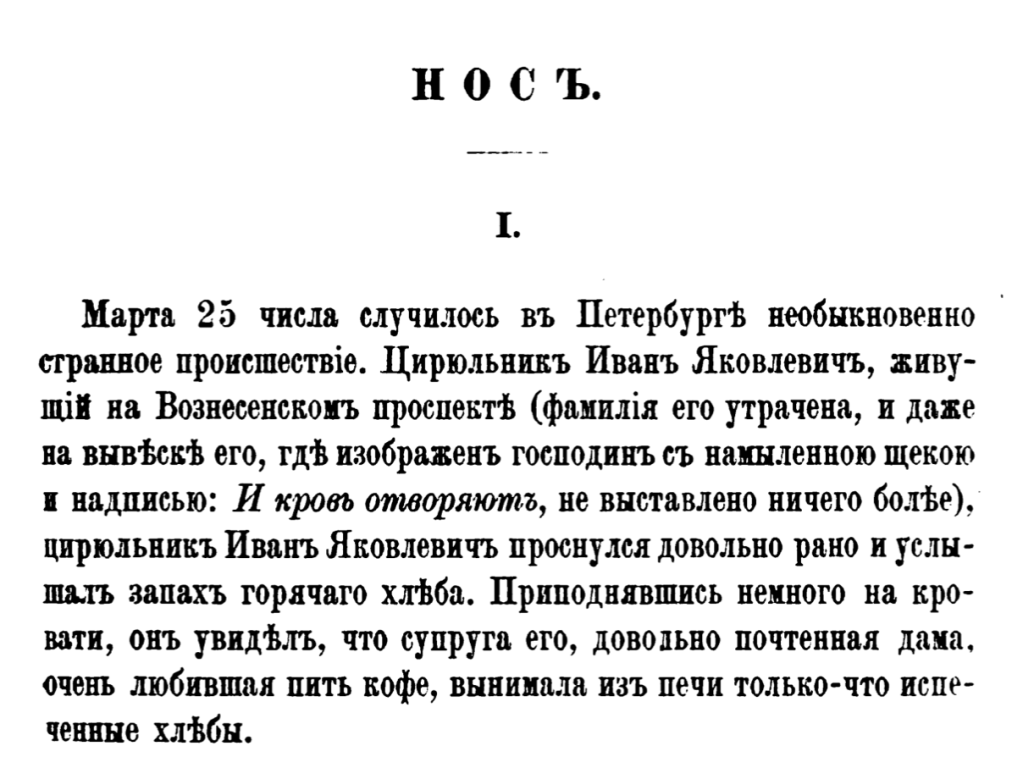
Полное собрание сочинений Николая Васильевича Гоголя, 1880

What is a Digital Scholarly Edition (DSE)?

There are plenty of digitized copies of Gogol’s complete works available in the original and in translation online (see previous post for the link to an English translation). A digitized edition is not a digital scholarly edition. Digital editions take advantage of the potential offered by digital modalities. Therefore, an analog text that has been digitized is just a digital surrogate for the original and functions the same way as the material text. A digital edition for a textual work has been encoded so that a computer can “read” it allowing further analyses to be performed on the structure, word choice, or any number of other elements within the text. 

Digital editions offer functionality based on their purpose: they usually entail some degree of user interactivity, often with expanded scholarly annotations and commentary, comparative views between similar texts or different versions of the same text, and searching capabilities. Digital editions are not text-exclusive, either, and may include high-quality digitized images of art work and pages from historic manuscripts with transcriptions of the text and any marginalia, as well as any necessary historical context. However, the most important aspect of a DSE is the critical engagement it allows through additional commentary, criticism, or context that transforms the text into a scholarly resource that also details the creation process and metadata for the project. Patrick Sahle’s chapter in Digital Scholarly Editing provides a thorough overview of how to define a DSE.

What you’ll notice when you peruse these digital scholarly editions and others is how different they can look and perform. The digital medium of these projects allow for a significant amount of customization depending on their intended purpose and audience. My choices for this Gogol project are not the only choices available. I will do my best to refer to alternative options and strategies when it makes sense to do so!

And while by no means emblematic of the entirety of digital scholarly editions, even the small list above raises questions of representation. Reflecting the kinds of texts and resources privileged over centuries for publishing and archiving, it is not a stretch to say that there is a disproportionate amount of space dedicated to white, European writers and historical figures, a problem that the digital humanities must be aware of or otherwise risk replicating inequities of the past. In upcoming posts, I’ll be discussing this issue, as well as issues of copyright, sustainability, accessibility, funding, and a multitude of technical considerations surrounding the theoretical and practical framework of digital scholarly editions and the digital humanities more generally.

Gogol and Identity: Past and Present

Amara Romero

When I was first assigned a short story by Nikolai Gogol in my intro class on the Golden Age of Russian literature, I expected him to feel distant. Often hailed as the “father of Russian realism”, Gogol’s work, like any writer’s, is of course a reflection of his time. I anticipated tales of 19th century clerks and government officers, all part of a monolithic cultural and historical identity that I, as a Mexican-American sophomore in college, would have little to no connection with while reading in the 21st century. Instead, I found a writer whose concerns and societal observations felt shockingly current. Gogol’s characters are constantly worried about status and identity, and many of them are situated in moral conflict surrounding the instability of who they are in the eyes of others. Considered and taught as a major figure in Russian literary tradition, Gogol’s own identity and personal history concretize the common theme in his writing of interrogating one’s place in society. As a Ukrainian-born writer whose early works drew heavily on Ukrainian folklore, culture, and landscape, Gogol and his writing resist being understood through a single national category, despite the language of composition. That complexity is what makes him continually relevant today. Across his portfolio, he repeatedly returns to unstable identities, shifting social roles, linguistic confusion, and characters left in the margins of the systems they are desperate to be recognized by. Gogol’s prevailing modernity lies both in the exceptionality of his style and storytelling, and in the way his life and fiction work in tandem to reveal how fragile identity can become when shaped by culture, language, bureaucracy, and empire. Reading Gogol today means encountering a world that is funny, strange, and unsettlingly recognizable, because it reveals how easily identity can be constructed, distorted, or claimed by others.

Gogol’s world is hilariously absurd, but that doesn’t mean that it doesn’t make any sense. Absurdism and humor often become the mechanisms by which his characters reckon with their place in bureaucracy, a system that regulates their entire lives. His main characters are often ordinary people: Akaky Akakievich in “The Overcoat”, Poprishchin in “Diary of a Mad Man”, and Kovalyov in “The Nose” are all civil servants. These characters’ obsessions with status and recognition ultimately reveal both how deeply identity depends on social validation and how absurd the systems of validation become when titles, uniforms, and appearances are treated as measures of human worth. Akaky Akakievich’s life and death become wholly focused on a coat, Poprishchin’s desire for status, and therefore worth, quickly spirals into delusion, and like Akakievich, is what leads to his undoing. When Kovalyov’s nose escapes his face and is found to be a higher-ranking official than its owner, Kovalyov’s peers refuse to help or believe him due to the disparity in status between the two parties. Gogol’s funny and absurd world, then, presents itself as something entirely apart from the “random silliness” that one could perceive upon a first read. Instead, it exaggerates the social pressures and irrational logic already built into ordinary social life. These social pressures remain pervasive today, when a question like “What do you do?” becomes synonymous with “What is your job?” The phrasing implies that work is not just one part of life, but one of the primary ways a person becomes socially legible.

This emphasis on status also makes identity in Gogol’s writing feel more like something performed for others, rather than something internally controlled and stable. His characters often read as ridiculous because of how intensely they care about how they are perceived, and the lengths they go to in order to address or “fix” this unstable perception. Akaky should need the overcoat for warmth, but this reason becomes marginalized when he realizes that his new coat allows him to be seen as more important to his coworkers. Poprishchin invents a royal identity because his actual social position feels unbearable, and Kovalyov panics over the loss of his nose because it disrupts the image of dignity and authority he believes he is entitled to project. In each case, identity is unstable, and mediated by an audience. Gogol’s characters want to appear important, respectable, intelligent, or socially valuable, and their desperation becomes absurd because their world has taught them that appearance is inseparable from worth. This is precisely where Gogol begins to feel especially modern. Contemporary life is not organized around the same imperial ranks, but it still asks people to perform identity and success through job titles, resumes, academic achievement, class markers, and constructed public identities. With modern displays of personhood through social media, for example, public life nowadays has almost become even more performative, with carefully constructed pages meant to demonstrate our lives to the world and those around us. We too are hyperfocused on how we are perceived by others, and through our modern systems, show the same desperation as Akaky, Poprishchin, and Kovalyov to control this perception. 

This instability that Gogol gives his characters is also reflected in Gogol’s own place in literary history, where his identity has often been claimed, simplified, and divided by national categories. Even though he was born in Ukraine, with much of his early work drawing on this background, he wrote in Russian, and is claimed and centralized in the Russian literary canon. His career shows that literary identity can be just as unstable as the identities of his characters. It can be shaped by qualities such as language or birthplace, or distorted entirely under the pressures of empire. Gogol’s characters struggle to control how they are seen under and within bureaucratic and social systems, and Gogol, posthumously, is frequently positioned by literary history within categories that cannot fully contain him. Asking whether Gogol is a “Russian writer” or a “Ukrainian writer” may be less revealing than asking why literary history has so often needed him to be one thing at a time, and why one category has so often been privileged over the other.

When I first encountered Gogol, I expected to meet a writer whose world would feel far removed from my own. However, I found that the distance I anticipated was part of what made his work so enduringly powerful. His clerks, officials, coats, noses, and absurd bureaucracies may belong to another century, but the anxieties beneath them remain familiar. It is impossible to claim that I connected to Gogol’s work because my world is the same as his, but situated comfortably within the realm of possibility is the idea that his stories deal with familiar things like status, work, ambition, embarrassment, and identity, which absurdity makes look strange enough that we can see them more clearly. Gogol’s world is funny because it is exaggerated, strange because it is distorted, and modern because it shows how fragile identity can become when it depends on recognition. What I initially imagined as a recollected, incomprehensible world from the past strangely and unexpectedly reflected my own, because it revealed how many of the questions his characters face have remained unsolved today.

A Re-introduction of Sorts…

A lot has happened since the three years that I last posted on The Digital Gogol Project. I was hired in my first role as a librarian at a community college. I gave birth to my third child. I learned new skills. I published a few articles. I helped re-launch a small, independent book press. I watched the world change dramatically. Life happened. 

I always intended to come back to this blog (at least I tell myself that). And yet, I did keep paying the yearly subscription fee for WordPress. There just never seemed to be enough time, mental space, money for training opportunities, or motivation. I also worried that I didn’t really know what I was doing in the first place.

And then I got my first full-time librarian job. In January of 2026, I became the humanities librarian at Oakland University in Rochester, Michigan. I’m an assistant professor and subject specialist for history, modern languages and literatures, and the Honors College. I’ve been there for six months, and it’s been wonderful. Suddenly, all the extra “stuff” I did in my free time – specifically the digital humanities stuff – is now part of my job. 

And here’s where it gets interesting.

A few months into my new role as humanities librarian, I was in a scholarship meeting with several of my peers. These meetings are opportunities for the newer library faculty to discuss what they’re working on, pose ideas and questions, and collaborate in a casual setting. Although I have established myself as a scholar of Chornobyl and the Soviet nuclear legacy (something that has since evolved to include the environmental violence of the Russian war in Ukraine), I have yet to figure out what my librarian scholarship should focus on. 

In one of those meetings, fueled by a need to talk about a “cool” idea and maybe gauge reactions as to taking this scholarly direction, I told everyone in that meeting that I was thinking about returning to a previous project. This project. Everyone reacted positively to my idea, even though internally I was already worrying about how I would even re-start something that I hadn’t even looked at for three years. For the most part, I avoided thinking about The Digital Gogol Project, because it represented failure, something that started with so much enthusiasm but fizzled out before it even really got going.

After that scholarship meeting, I figured I would think about reviving this project for a couple of months before getting distracted by something else. While I still thought it was a cool idea, it’s a big project with the potential for overwhelm. The next morning, however, I woke up to an email from a student at Middlebury. She could read Russian and loved Nikolai Gogol’s stories. She had seen my blog and wondered if it was still active. If it was, she wanted to help out over the summer. 

Serendipity? A blessing? Unbelievable luck? Whatever it was, I took it as a sign from the universe that I needed to revive The Digital Gogol Project. And that is just what we (I along with my collaborator Amara) are doing. This project started off as a means of exploring the digital humanities, and that will still be its focus. We will be exploring Gogol’s Petersburg Tales, a collection of short stories written between 1835-1842 set in the capital of the Russian Empire, St. Petersburg. We will be encoding every text and using computational methods to bring them to life in new ways. We will be documenting both the technical process and our personal experiences, as well as Gogol’s life and the historical context of his writing. We will be thinking about Gogol’s status in the Russian literary canon and his Ukrainian heritage in the shadow of Russia’s aggression toward Ukraine. We will be experimenting with new technologies and learning new skills. We will become digital humanists (maybe we already are).

The Text: Gogol’s “The Nose”

Вдруг он стал как вкопанный у дверей одного дома; в глазах его произошло явление неизъяснимое: перед подъездом остановилась карета; дверцы отворились; выпрыгнул, согнувшись, господин в мундире и побежал вверх по лестнице. Каков же был ужас и вместе изумление Ковалева, когда он узнал, что это был собственный его нос!

– Nikolai Gogol, “The Nose”

“The Nose” is a fantastic story. The first time I read it, I could not believe what I was reading – it was absolutely absurd. Published in 1836, in a journal owned by Aleksandr Pushkin no less, this satirical story begins when a barber named Ivan Yakovlevich finds a nose in his wife’s freshly baked bread. He recognizes it as the nose of Collegiate Assessor Kovalyov, one of his regular customers. Yakovlevich dumps the nose into the river so as not to be found with it. Meanwhile, Kovalyov, a contemptible bureaucrat, wakes up to discover his nose has gone missing. A man so concerned with appearances and status, Kovalyov is mortified. Although he attempts to hide his new deformity, he soon becomes the center of Petersburg gossip when he runs into his nose galavanting around St. Petersburg. What is worse for Kovalyov is that his nose has apparently become a higher ranking bureaucrat than he himself! Kovalyov does eventually get his nose back and any lessons he may have learned from the strange occurrence are quickly forgotten. The various interpretations of Gogol’s story are tangential to this project (Is is about repressed homosexuality? a criticism of Russian social hierarchy? absurdity for absurdity’s sake?), I chose this story purely out of love, because it’s one of my favorite short stories. So if you haven’t read it, please read it here.

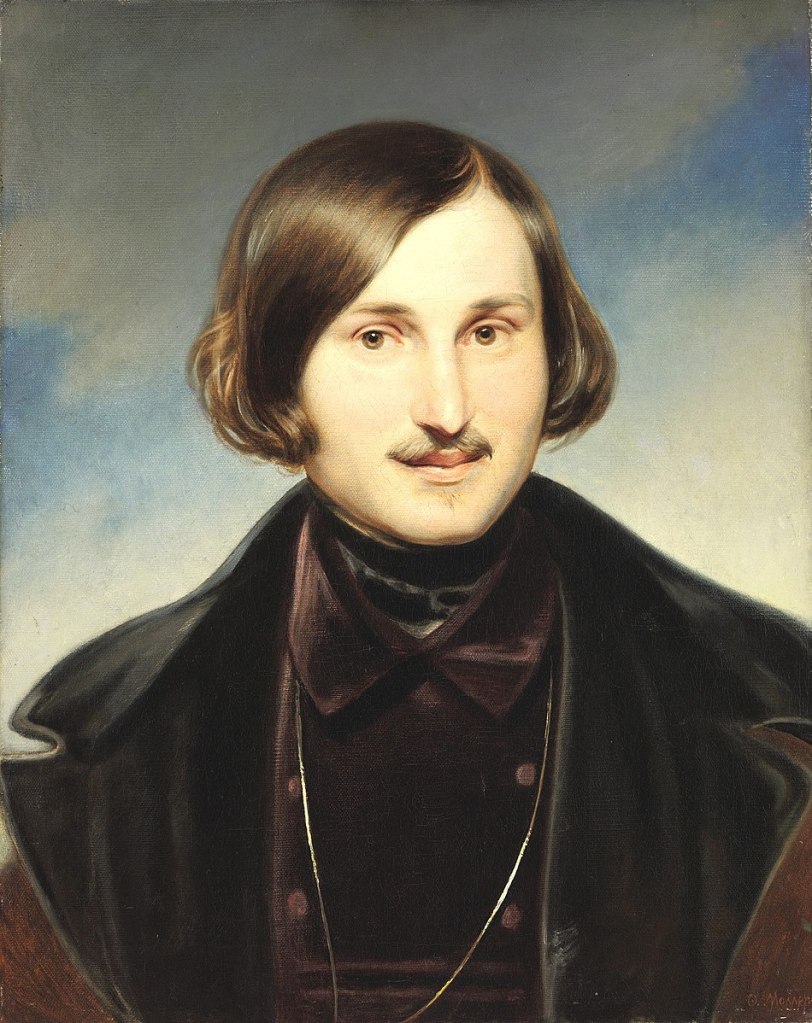
Portrait of Gogol, 1841, by Otto Friedrich Theodor von Möller.

An important note on language:

“The Nose” was originally written in Russian, and this digital edition will utilize Russian texts. I acknowledge that Nikolai Gogol is part of the Russian literary canon, but this is where things get interesting. Gogol is Ukrainian. He was born in the village of Velyki Sorochyntsi, Ukraine and therefore, he also belongs to Ukrainian literature ( and I would be remiss if I didn’t point that out). In fact, part of the reason why I chose Gogol for this project is because he uses the Russian AND Ukrainian languages in both his literary works and personal life. For example, as much as Gogol is known for his Petersburg tales (“The Nose” being one of them), his letters and notes are often written in Ukrainian, some of his characters speak Ukrainian, and many of his stories are about Ukraine. In the future, as I expand to other works and personal writings, this will become more apparent.

Of course, in the background of this whole project is the long shadow cast by a history Russification in Ukraine and issues of language and identity. These questions of language and identify are made all the more pertinent given the contentious relationship between the two countries and the recent 2014 invasion of Crimea and 2022 war in Ukraine. I refer you to this poignant essay, written by Ukrainian-American poet Ilya Kaminsky, to illustrate some of the complexities of language, which have origins from Gogol’s time, during which the Ukrainian language was banned in schools. In this context, writing in Ukrainian takes on a subversive quality that also resonates with Gogol’s bitingly satirical depictions of Russian bureaucracy and society. I’m not sure how this will play out as this project develops, but I’m curious.

Welcome!

Hello! My name is Haley and I’m a long-time academic scholar turned librarian. I’m interested in the intersections of text and digital technology, and how this thing we’re calling the digital humanities can enrich and expand our understanding of what is possible in terms of humanities research. To that end, I’m going to create a digital edition. I’m going learn how to mark up a text so that a computer can read and analyze it. I’m going to turn a static text into something a bit more dynamic and interactive. And since I can never really leave Slavic Studies behind, I am going to create a digital edition of Nikolai Gogol’s short stories, starting with “The Nose,” and I’m going to use this project to talk about the work of the digital humanities and digital scholarship.

My introduction into DH came while I was a doctoral student in Slavic Languages and Literatures. As much as I love the subject matter, I found myself quickly disillusioned with the field. If academia can be slow to change, Slavic Studies as a whole is notoriously conservative and unyielding. In some ways, doing the work of Slavic Studies feels like being stuck on a rickety old ship embarking ever so slowly on a path already charted. You don’t know how to get off this boat, perhaps even have some vague ideas about hijacking the whole thing, but the ship is so heavy and hard to re-direct. You find yourself channeling Mayakovsky when he and his contemporaries first penned the Futurist Manifesto all those years ago. Maybe there is no steering the ship. You need to jump, but the waters are murky. And you don’t know how to swim—no one taught you how! Meanwhile, you’re watching other graduate students engage with some interesting interdisciplinary research—stuff that’s relevant and meaningful to our contemporary experience—while you are working with outdated tools and the burden of tradition.

This blog and the project for which it was created is my attempt to “swim,” to grapple with not only some interesting tools and approaches, but also with my intellectual and professional future. Inspired by other DH projects such as Digital Dostoevsky, I am going to create a digital edition and document the process here as I go along. Open access, collaboration, and public engagement are core values of the digital humanities, and I will endeavor to make the process of creating this digital edition as transparent and accessible as possible. To that end, I’ll be including helpful resources, tips, and explanatory materials that informed my research and creative process with every post. I hope this might be a place that supports learning and innovative thinking, as well as a forum to connect and share ideas.

We need new perspectives and modes of analysis to breathe life into our approach to Slavic literature and humanistic inquiry in general. These kinds of tools and methods are not meant to displace traditional modes of inquiry and research, but to complement and challenge tired assumptions of what it means to extract meaning from a text. The digital humanities may be able to help change how we conduct and support humanities research, BUT there’s still a lot of work to be done. While I cannot yet speculate on exactly how this particular project will turn out or what research questions will be answered, I do hope to learn a lot about how DH and Slavic Studies intersect. I also hope that this may serve as a useful guide for someone out there (maybe even you) looking to start their own DH project.