Вдруг он стал как вкопанный у дверей одного дома; в глазах его произошло явление неизъяснимое: перед подъездом остановилась карета; дверцы отворились; выпрыгнул, согнувшись, господин в мундире и побежал вверх по лестнице. Каков же был ужас и вместе изумление Ковалева, когда он узнал, что это был собственный его нос!
– Nikolai Gogol, “The Nose”
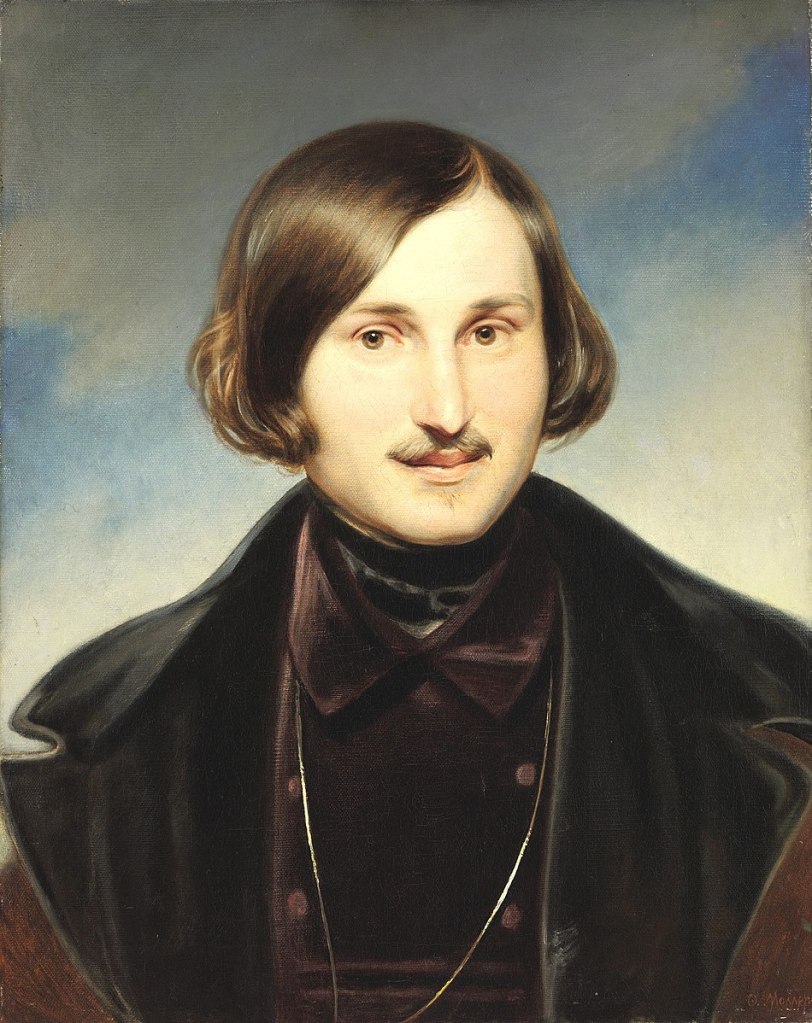
“The Nose” is a fantastic story. The first time I read it, I could not believe what I was reading – it was absolutely absurd. Published in 1836, in a journal owned by Aleksandr Pushkin no less, this satirical story begins when a barber named Ivan Yakovlevich finds a nose in his wife’s freshly baked bread. He recognizes it as the nose of Collegiate Assessor Kovalyov, one of his regular customers. Yakovlevich dumps the nose into the river so as not to be found with it. Meanwhile, Kovalyov, a contemptible bureaucrat, wakes up to discover his nose has gone missing. A man so concerned with appearances and status, Kovalyov is mortified. Although he attempts to hide his new deformity, he soon becomes the center of Petersburg gossip when he runs into his nose galavanting around St. Petersburg. What is worse for Kovalyov is that his nose has apparently become a higher ranking bureaucrat than he himself! Kovalyov does eventually get his nose back and any lessons he may have learned from the strange occurrence are quickly forgotten. The various interpretations of Gogol’s story are tangential to this project (Is is about repressed homosexuality? a criticism of Russian social hierarchy? absurdity for absurdity’s sake?), I chose this story purely out of love, because it’s one of my favorite short stories. So if you haven’t read it, please read it here.
An important note on language:
“The Nose” was originally written in Russian, and this digital edition will utilize Russian texts. I acknowledge that Nikolai Gogol is part of the Russian literary canon, but this is where things get interesting. Gogol is Ukrainian. He was born in the village of Velyki Sorochyntsi, Ukraine and therefore, he also belongs to Ukrainian literature ( and I would be remiss if I didn’t point that out). In fact, part of the reason why I chose Gogol for this project is because he uses the Russian AND Ukrainian languages in both his literary works and personal life. For example, as much as Gogol is known for his Petersburg tales (“The Nose” being one of them), his letters and notes are often written in Ukrainian, some of his characters speak Ukrainian, and many of his stories are about Ukraine. In the future, as I expand to other works and personal writings, this will become more apparent.
Of course, in the background of this whole project is the long shadow cast by a history Russification in Ukraine and issues of language and identity. These questions of language and identify are made all the more pertinent given the contentious relationship between the two countries and the recent 2014 invasion of Crimea and 2022 war in Ukraine. I refer you to this poignant essay, written by Ukrainian-American poet Ilya Kaminsky, to illustrate some of the complexities of language, which have origins from Gogol’s time, during which the Ukrainian language was banned in schools. In this context, writing in Ukrainian takes on a subversive quality that also resonates with Gogol’s bitingly satirical depictions of Russian bureaucracy and society. I’m not sure how this will play out as this project develops, but I’m curious.
 The Digital Gogol Project